
with Bas Donkers and Stefan Stremersch, Marketing Science 30 (2), 2011, 305-320
After years of investment in R&D, pharmaceutical firms have a limited window to sell a new drug and recap the investment. Therefore, timing is key. Yet, even when a company can show it has a superior drug in at least some critical dimension for doctors and patients (think of efficacy, side effects), the real question is: how fast will the company be able to convince HCPs to prescribe it? How fast does a new drug diffuse, and why?
Few markets illustrate this better than the respiratory drug space in the early 2000s. This was one of the most intense competitive battles in pharma, with AstraZeneca and GSK fighting for dominance. At the center was the launch of Symbicort, AstraZeneca’s new combination therapy, competing head-on with GSK’s Seretide/Advair.
In this research, coauthored with Bas Donkers and Stefan Stremersch, I studied the diffusion of Symbicort in the Dutch market (2001–2006), a period that allows us to observe adoption from launch onwards (see Fig 1 below, from the paper).
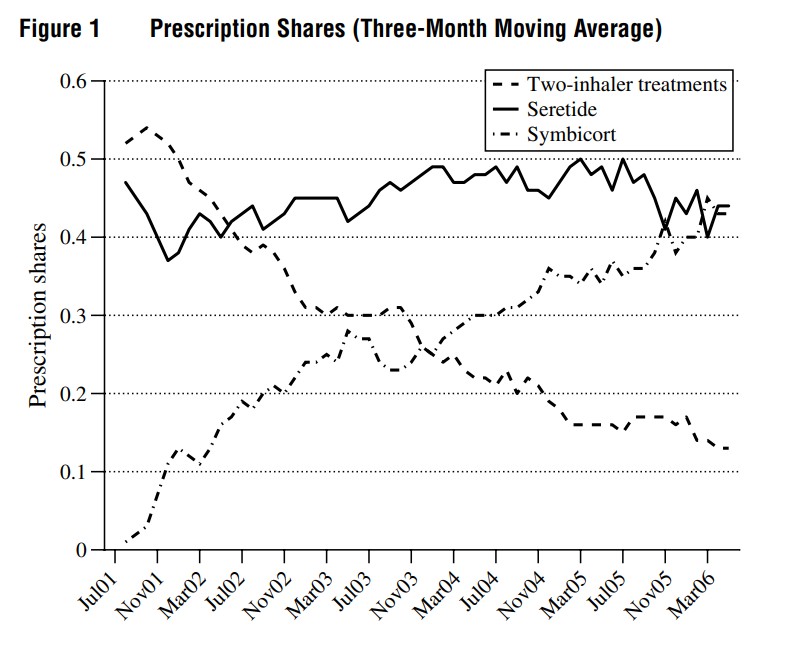
What makes this setting particularly powerful is the data we used. We use a unique panel from Dutch general practitioners who were already working in fully digital, paperless environments at the time (IPCI dataset). Every prescription (new and repeat) was digitally recorded, along with full patient histories, all before the approval of Symbicort in the Netherlands. This enabled us to track, with unusual precision, how physicians learn and update their beliefs about a new drug, using patient feedback as their source of knowledge.
The key insight is that diffusion is not just about clinical evidence or marketing effectiveness. It is also strongly shaped by how physicians learn from their patients’ experience. And what we show is that learning-from-patients is “biased” towards giving more attention and weight to the most dissatisfied patients. Specifically, certain patient outcomes and feedback are more salient, more memorable, and therefore disproportionately influential in HCPs’ decisions. In the data, feedback from a small number of “salient” dissatisfied patients can outweigh a much larger set of satisfied patients with good experiences, slowing down adoption.
This was, to our knowledge, the first use of the IPCI database outside medical sciences, and the first in economics and marketing. It allowed us to show something simple but powerful: even in high-stakes, expert-driven markets, diffusion is governed by how outcomes are experienced, communicated, and remembered.
Source:
Camacho, Nuno, Bas Donkers, and Stefan Stremersch (2011), “Predictably non-Bayesian: Quantifying salience effects in physician learning about drug quality,” Marketing Science 30(2), 305-320.